Sort of agree. But one of the advantages of having a bowl game is the extra practice time. Coach Mac was very high on how important that was.
3 Likes
Yeah, I get that. But I’m just talking about the games themselves. The quality is so low. You have so many opt-out and injuries that the games are basically spring-game quality.
3 Likes
Wait, you’re saying that watching the 2nd and 3rd string players on 7-5 MAC teams doesn’t make for interesting viewing?
I’m shocked, I tell you. Shocked! 
2 Likes
The whole extra practice line is easy enough to address. It doesn’t need to be tied to unwatchable stupid scrimmages.
The playoffs will only expand (for better or worse). So eliminate the extra games or make an NIT playoff. Either way we all know it’s not for the fans, and at this point it isn’t for most of the players either. It’s for advertisers and a few old guard that don’t seem to understand the world has moved on. And since these players are now employees, most are too valuable to waste in a meaningless tv show no one watches or buys tickets to.
3 Likes
This take makes sense but 26 days off and never being in this situation as a coach or a team could be a factor. On talent Alabama should beat them but so should Ohio State.
Google ‘Cignetti’. He just wins . But yes, the long layoff actually does not favor the top 4. Being the 5th seed may be the sweet spot - get a home game against the token G5 and get revenue and break up the long layoff. Maybe on talent Alabama has the edge, but Indiana has a top 5 offense and defense. But perhaps Alabama is hoping for a Heisman curse.
3 Likes
Where was that winning when he was on Bama’s staff for the Sugar bowl vs Utah 
4 Likes
**What’s the future of bowl games? Bowl Season director talks impact of CFP, opt-outs and more
College football’s 41-game bowl schedule kicked off Dec. 13 with Washington beating Mountain West champion Boise State 38-10 at the LA Bowl. The game featured two widely known programs at SoFi Stadium, and Nielsen ratings data showed 4.1 million viewers tuned in.
But the six-day turnaround from selection to kickoff led to an announced crowd of 23,269. The LA Bowl is likely to expire after four games, which was first reported by On3’s Brett McMurphy. And the swirl of coaching news, player movement, teams declining bowl invitations and potential College Football Playoff expansion discussions dwarfed any discussion about the game’s outcome or any non-CFP result.
The bowls are in a precarious position in today’s college football. The CFP operates through them in the quarterfinals and semifinals, but the popularity of first-round on-campus matchups and potential CFP expansion to 16 teams, combined with player and team opt-outs, could lead to a further devaluation. But Bowl Season executive director Nick Carparelli sees coexistence between the bowls and a growing tournament through a transition era.
“We certainly have our issues that need to be resolved, but there’s probably not one issue that college athletics faces in general that doesn’t need to be reevaluated,” Carparelli said. “At this point in time, we’re going through a major transition in the sport, and we’re excited to talk to our conference partners once bowl season’s over to work with them to decide, what does bowl season need to look like in the future?”
Carparelli spoke with The Athletic on a number of bowl-related topics as the postseason takes root throughout holiday week. The first relates to how the bowls can survive alongside CFP expansion.
When the four-team College Football Playoff began in 2014, the sport’s hierarchy determined that 12 teams would comprise the upper-level New Year’s Six bowls. Then, when the CFP included all 12 teams, those six bowl games operated in the quarterfinals or semifinals, which changed little in the outside bowl system. However, more expansion takes away four teams from the upper tier of non-CFP bowls. How much will that detract from bowl games?
I think it’s inevitable that it goes to 16 — and I think it should be — but let’s get to a number that makes sense and stick with that for a period of time and really evaluate how that works for college football. I think anything beyond 16 seems a little far-fetched to most people. Sixteen is going to require every team who wants to win a championship to win four games. Even the NFL doesn’t play more than four postseason games. So, I think 16 is where we probably will end up, and the bowl system will adjust just fine.
There are still more than 16 teams in any given season that have earned the right to play in the postseason and to celebrate a successful season. Because let’s not forget, the definition of success is very different, depending on the football program.
After it was snubbed for a CFP spot, Notre Dame chose not to compete in a bowl game. Kansas State and Iowa State opted out after losing their head coaches and cited players’ injuries as a major concern. The bowl system already needed two transitional teams (Missouri State and Delaware) to fill all 82 bowl slots, then the dropouts forced a mad scramble among the bowls to land three 5-7 teams. In the current climate, are there too many bowl games?
The bowl system is a market-driven system. Through the 100 years of bowl games, no one has ever dictated how many bowl games there are. They’ve been strictly a function of host communities that want to host them and teams that want to participate.
If at any point in time, the institutions decide as much as we love the bowl system, we may want to participate at a different level, then the bowl system will adjust accordingly. But no one’s in a position to say what the number is, or to make any of those decisions. The market will dictate it.
Should the final number of bowl games adjust each year based on interest and availability? In 2021, a separate bowl game was set up in Frisco, Texas, to ensure every bowl-eligible team received a postseason destination.
I think it can, for sure. We’ve proven that can be the case. The problem is we go into each season guessing how many bowl-eligible teams there are and how many teams want a postseason opportunity. You get to the end of the year, and the odds are that the numbers aren’t going to match up exactly. I think that’ll be one of the discussion topics that we have with the conferences in the offseason. How do we accommodate all the teams that want to participate in the postseason without having to stress over the teams that don’t?
Bowl contracts expire after this cycle and the sport has changed more in that six-year stretch than at any other in college athletics history. There was a pandemic at the front end, sweeping changes allowing athletes to receive payment for services, a College Football Playoff that tripled in size and 45 FBS conference affiliation changes.
The bowls have stayed in place as the world has changed. Former Pac-12 teams in the Big Ten, Big 12 and ACC remain under that league’s contract. Texas and Oklahoma are now part of the SEC’s alignment, which changes what teams the Big 12 can provide to its bowl partners. What can the bowl system prepare to do for the 2026-27 cycle, or does everything still hinge upon the CFP format?
Their conversations about college football’s postseason to this point has strictly revolved around the College Football Playoff. They need to make that decision first, and then they can move on to the rest of the bowl system. And we’re excited for that opportunity to talk to them about it.
Even though no decisions have been made, conversations have been ongoing between bowl games and their current conference partners, as well as some potential future conference partners. If the commissioners are to make a long-term decision on the CFP, then I think both the conferences and the bowl games would like to put long-term partnerships in place. But even at this late date, less than a year away from the 2026 bowl season, there’s still too many unknowns to make any definitive decisions.
All the bowl games that had a partnership with the former Pac-12 have had to juggle a lot the last couple of years, and I’m sure they would like to be out from under that arrangement as soon as possible.
Despite all of the chaos and public discourse over bowl games, there’s still an interest. Last year, nine bowl games picked up more than four million viewers, with BYU-Colorado hitting eight million in the Alamo Bowl, Iowa State-Miami picking up 6.79 million for the Pop-Tarts Bowl and Michigan-Alabama reaching 6.55 million in the ReliaQuest Bowl. Which bowls do you think have a chance to garner similar public interest?
I think the ReliaQuest Bowl (Vanderbilt-Iowa), for sure, is going to get a lot of eyeballs. You have two really motivated teams that have had successful seasons, even though they haven’t made the Playoff. And two teams that love playing football, which is something that gets lost in all of this, the opportunity to play one more game together as teammates is really valuable to those two teams.
The Pinstripe Bowl is an intriguing matchup. You have Clemson against Penn State, two teams that were in the preseason top 10 that a lot of people thought might meet in the Playoff that didn’t work out.
1 Like
Make the playoffs 16. Create 20 additional bowl slots and make the bowl interest groups bid for those spots. Require 7 wins to enter a bowl game firm. I could live with that…barely.
Really I’d rather see the 16 team playoff and maybe 10 exhibition games for the next 20 teams in the ranking..and everyone else just gets to elect to have additional weeks of practice. The end.
3 Likes
Ga Tech keeps shooting themselves in the foot. Fortunately for them, so does byu-provo.
2 Likes
BYU will pull this one out. They always seem to.
3 Likes
Yep. Ga Tech is gonna lose this game.
3 Likes
This is like the 100th time this season BYU has trailed by two scores, and they have ome back to win. Makes me want to vomit.
4 Likes
LOL @ GA Tech
2 Likes
Well, that was disappointing.
3 Likes
And, of course, the player of the game for BYU may very well have been former Ute Carsen Ryan. Sigh.
1 Like
A snip from The Athletic this morning;
BYU wins silly sideshow with storyline stakes
Yesterday was, volume-wise, the biggest day of the postseason in major college football. There were eight nationally televised bowl games, highlighted by:
This Orlando-based bowl — formerly the Cheez-It, Camping World, Champs Sports, etc. — took on the Pop-Tarts label in 2023. Thanks to its embrace of absurd spectacle, it has quickly come to define all of non-Playoff bowl season, becoming both a truly mainstream crossover event … and as a stand-in for all of bowl season’s alleged frivolity. (When Ole Miss coach Pete Golding was asked about the challenge of keeping the Rebels focused after Lane Kiffin left, he said it was no problem because this was the Playoff and not the Pop-Tarts Bowl.)
It’s long been a common refrain that non-Playoff bowls don’t matter. Player and coach opt-outs (even whole-team opt-outs) have watered them down a bit. Per-game attendance is lower than it was 25 years ago, while the number of bowls has almost doubled in that span. As far back as 2000, Big East commissioner Mike Tranghese was telling reporters that the BCS Championship (est. 1998) had created a “hangover” in bowl attendance. Conversations about the viability of bowls are not unprecedented, not at any point in the past hundred years.
But if people vote with their remote controls, then non-Playoff bowls are far from dead. TV ratings have performed well in recent years. When numbers for this weekend come out, they will probably look nice yet again.
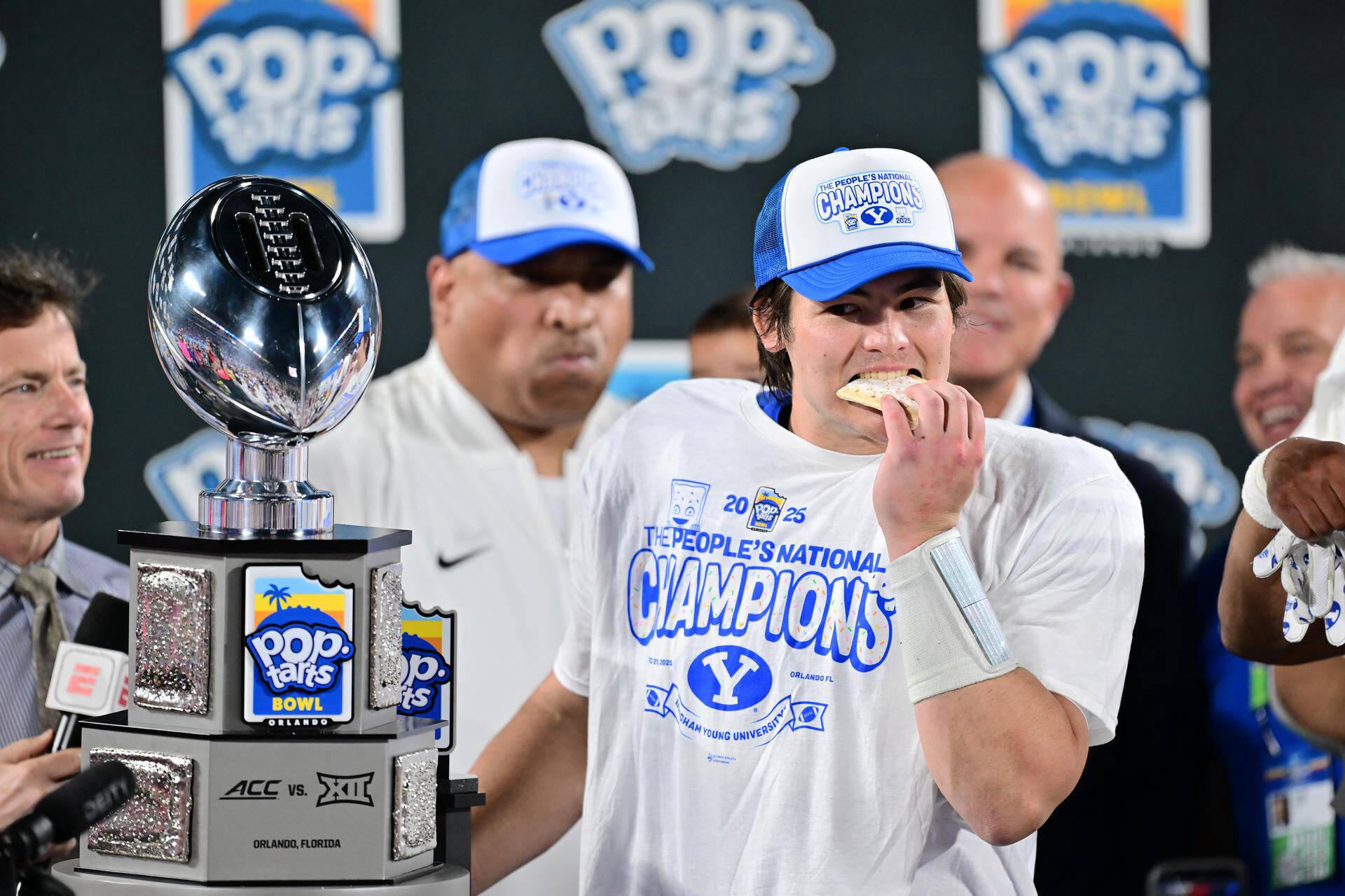
That will certainly be the case for yesterday’s biggest Pop-Tarts Bowl yet. Final score: No. 12 BYU 25, No. 22 Georgia Tech 21. The Cougars overcame a 21-10 fourth-quarter deficit, sealing it with an interception of Haynes King in the end zone. (A shame for King’s excellent college career to end that way, but alas.) The postgame sacrifice of multiple Pop-Tarts then included a cliffhanger, as the Protein Pop-Tart (sure, try to keep up) declined to be sacrificed, vowing to return. Also, you will not believe how quickly Kalani Sitake can house a celebratory pastry.
BYU claims another mantle here: The Cougars are now the non-Playoff national champions of 2025. Remember, Notre Dame decided not to Pop-Tart. Perhaps the Irish could’ve beaten BYU in what would’ve been a legitimately huge game, then used it as additional evidence that the committee had screwed them by taking Alabama instead. Instead, Notre Dame left that lane open for someone else.
The Pop-Tart Bowl just feels right as the place to crown the Snubbed National Champ, whose fans can now spend the offseason insisting that things would’ve gone down differently if their team had been allowed in the Playoff. Congrats to the Cougars. Hang the banner.

1 Like
l[quote=“LAUte, post:58, topic:9828, full:true”]
A snip from The Athletic this morning;
BYU wins silly sideshow with storyline stakes
Yesterday was, volume-wise, the biggest day of the postseason in major college football. There were eight nationally televised bowl games, highlighted by:
This Orlando-based bowl — formerly the Cheez-It, Camping World, Champs Sports, etc. — took on the Pop-Tarts label in 2023. Thanks to its embrace of absurd spectacle, it has quickly come to define all of non-Playoff bowl season, becoming both a truly mainstream crossover event … and as a stand-in for all of bowl season’s alleged frivolity. (When Ole Miss coach Pete Golding was asked about the challenge of keeping the Rebels focused after Lane Kiffin left, he said it was no problem because this was the Playoff and not the Pop-Tarts Bowl.)
It’s long been a common refrain that non-Playoff bowls don’t matter. Player and coach opt-outs (even whole-team opt-outs) have watered them down a bit. Per-game attendance is lower than it was 25 years ago, while the number of bowls has almost doubled in that span. As far back as 2000, Big East commissioner Mike Tranghese was telling reporters that the BCS Championship (est. 1998) had created a “hangover” in bowl attendance. Conversations about the viability of bowls are not unprecedented, not at any point in the past hundred years.
But if people vote with their remote controls, then non-Playoff bowls are far from dead. TV ratings have performed well in recent years. When numbers for this weekend come out, they will probably look nice yet again.
That will certainly be the case for yesterday’s biggest Pop-Tarts Bowl yet. Final score: No. 12 BYU 25, No. 22 Georgia Tech 21. The Cougars overcame a 21-10 fourth-quarter deficit, sealing it with an interception of Haynes King in the end zone. (A shame for King’s excellent college career to end that way, but alas.) The postgame sacrifice of multiple Pop-Tarts then included a cliffhanger, as the Protein Pop-Tart (sure, try to keep up) declined to be sacrificed, vowing to return. Also, you will not believe how quickly Kalani Sitake can house a celebratory pastry.
BYU claims another mantle here: The Cougars are now the non-Playoff national champions of 2025. Remember, Notre Dame decided not to Pop-Tart. Perhaps the Irish could’ve beaten BYU in what would’ve been a legitimately huge game, then used it as additional evidence that the committee had screwed them by taking Alabama instead. Instead, Notre Dame left that lane open for someone else.
The Pop-Tart Bowl just feels right as the place to crown the Snubbed National Champ, whose fans can now spend the offseason insisting that things would’ve gone down differently if their team had been allowed in the Playoff. Congrats to the Cougars. Hang the banner.
[/quote]
I love the non playoff games but that’s just me. It’s a shame that the Zoobs won the prestigious Pop Tart Bow
4 Likes